Olloclip: Up Close & Personal

The Olloclip is a handy 3-in-one lens attachment for the iPhone 4 and 4S that lets you take wide angle, fisheye or macro shots rather easily. The clip itself is small enough to fit in the palm of your hand or your pocket and is easily attached simply by sliding it directly over the lens of iPhone’s built-in camera. The Olloclip contains a funky fisheye lens on one side and a wide angle lens on the other. This wide angle lens can be unscrewed to reveal the macro lens which allows you to take super close-ups (12-15mm) which are great for getting shots of insects, fauna or surface textures.

I’ve been using my Olloclip for the past few months and I have to say I’ve really enjoyed it. I’ve always been interested in macro photography but didn’t want to spend hundreds of dollars on expensive SLR’s and associated lenses. While the images the Olloclip produces may not be National Geographic quality, I’ve found them to be quite good, and certainly good enough to satisfy my hobby. I initially bought the clip to photograph a few Swallowtail caterpillars who had made their home on some parsley I had planted. The shots came out so good, I was soon hooked and have found myself constantly looking for fun macro subject matter. Head over to my Flickr set of Olloclip macro shots to see some examples I’ve posted.

While the macro lens is by far my favorite feature of the Olloclip, the wide angle has also come in handy. I love being able to get a more complete image when snapping a picture of a room or a group of people with the Olloclip, although I have found that the resulting images seem dimmed at the very fringe of the optics. I’ve read that real estate agents LOVE the Olloclip’s wide angle feature and I can understand why. The fisheye lens is fun for unique occasions, but too funky for every day use. Every picture taken with the fisheye looks like you’re looking out a peephole, great as a novelty but the resulting images are too strange for every day use.

About the only downside I can see to the product is that it can only be used when your iPhone is naked. If you keep your iPhone in a case (even an extremely thin one) then you must remove it from the case in order to slip on the Olloclip. I completely understand why this is necessary, it just increases the time and effort it takes to get the shot you want, especially if you’re shooting a finicky subject like bugs. By the time you get your case off, the Olloclip on and the wide angle lens unscrewed, your butterfly may be long gone. I also wish it was “universal” in design and worked on both the iPhone and the iPad, although admittedly I don’t see how a single design could accommodate both devices.

The Olloclip started life as a Kickstarter campaign that raised the necessary funding and began production in June of 2011. It can be purchased in Apple retail stores or online for around $65 and is well worth the price. Considering similar SLR lenses will set you back hundreds of dollars, the Olloclip is a great way for amateurs to have their photographic cake and eat it too. Macworld gave the Olloclip four out of five mice, and the rating was well deserved. It’s a joy to use and has increased my love of digital photography by an order of magnitude. I highly recommend it.

Entrenched

Over the past few years, there’s been a significant increase in the polarization of people’s opinions in this country. More and more, folks are unwilling to put themselves in other people’s shoes, to see their side of the story or even just listen to what they have to say. Increasingly, we as a society are either unwilling or unable to compromise on important topics that affect the vast majority of us. I’m not sure where or when this started, but I do think much of it has to do with the Internet.

Since it came into wide-spread adoption, the Internet has been a way for people of widely varied viewpoints to express themselves on any number of topics. We can read, post, blog and tweet all from the comfort of our own homes and what we say is seen by hundreds, thousands or even millions of people. More importantly, when we say something online we do so from the relative safety of digital anonymity. Although some people hide behind pseudonyms online, these days it’s more common to see people representing themselves honestly and openly. Just because they do however, doesn’t mean that we “know” them or are friends with them or even have met them in real life and I think that is an important distinction.

When we sit down and have a conversation with our family, friends or even acquaintances, we often censor ourselves for the good of our relationships. We may think someone’s opinion isn’t valid or is something we consider to be foolish, but we probably won’t tell them that to their face. Instead we often try and steer those we disagree with towards mutual understanding, we give and take, we compromise. I love my family very much but I disagree heartedly with many of their political viewpoints. When I get into a discussion about these topics with them, I don’t call my Uncle an idiot or a bozo, I calmly listen to his opinion, and if I’m feeling feisty I’ll attempt to convey some opposing viewpoints. If he listens great, if he entrenches himself and refuses to hear what I’m saying I often change the subject and move on. I love him too much to risk hurting him or his feelings and so I censor myself to some degree. I firmly believe it’s for the best.

But when I frequent political blogs and forums and told I’m an “ignorant liberal” or when I tweet about Apple’s court victory over Samsung and am called a “typical Apple fanboi”, the people that do so have no pretenses about censoring themselves. Indeed, I too am more likely to let loose when I’m exchanging ideas and thoughts with someone I’ve only met online than I would if I were sitting with them face-to-face in a restaurant or coffee shop. Yesterday, Macworld editor Dan Frakes tweeted this about Apple’s original iPhone:

As soon as I saw that tweet, I knew Dan was in for an earful. I had tweeted several times on Friday about the $1.01B judgement against Samsung by Apple and was not prepared for the amount of staunch anti-Apple sentiment that flowed into my Twitter timeline as a result. It seems that in platforms, as in politics, people have firmly chosen sides. You’re either with us or your against us and for some reason there can be no middle ground. I make my living using Apple products and have enjoyed them for well over 20 years so I have a strong affinity for technology that comes out of Cupertino. I also like to think that I’m fairly objective and have criticized Apple when I strongly disagree with a position they take. Sadly, some don’t see it this way. Apple is either the perfect corporate citizen who can do no wrong or a demon that is out to destroy open standards and lock all smartphone users into walled gardens manned by underage Chinese workers from Foxconn.

The reality, of course, is somewhere in-between. Apple’s victory over Samsung can be right and just in accordance with U.S. patent law but that doesn’t mean they “invented rounded rectangles”. It also shouldn’t mean that you and I can’t have a friendly discussion on the topic without it devolving into the digital equivalent of the Jerry Springer Show. Admittedly, when we are so entrenched in our positions it is difficult to give up any ground, especially when one feels passionately about something. However, if we are to survive and flourish as a society and have meaningful conversations, we all need to try and make a concerted effort to climb out of our fox holes and meet somewhere in the middle.

Lost Cities Tips & Tricks

Lost Cities is a new game for iPhone from TheCodingMonkeys, publishers of the hugely popular Carcassonne. Based on the award winning card game by Reiner Knizia, Lost Cities takes elements of solitaire and combines them with vibes of Uno and Go Fish into a compelling game for two people or a single player vs any one of four AI opponents.

The game is easy to learn (I won’t go into the full rules here) thanks to the wonderful spoken in-game tutorials, but the basic object is to score points by playing cards of increasing value in any one of five, colored channels. Whichever player has the most points when all the cards from the draw pile have been played, wins. Since the Iconfactory did much of the graphical work for Lost Cities, I was generously given early access to the pre-release and have been playing a great deal this past week. I’ve learned a lot in that time and I wanted to share some of the insights I’ve had with would-be challengers.

Practice Against the AI

It may seem straight forward but playing the various computer opponents is a great way to get a feel for Lost Cities. Playing the AI means the game proceeds quickly since you don’t have to wait for a human friend to move. Getting into a rhythm in LC really helps you to understand how points are scored, cards are held or discarded and what to watch for.

Watch the Draw Pile

The game continues only as long as there are cards to draw so keep a close eye on the number of cards left in the pile in the lower right of the interface. When that number reaches zero, the game is over so it’s important to know how many turns are left. Don’t wait until the last few turns to play your big cards if you can help it. Also, remember that the number of turns is just about one half of the number of cards left in the deck. It’s easy to look at 18 on the deck and think you have that many turns left, but you really don’t, you have approximately 9!

Ditch the 2′s and 3′s

Unless you’re trying to make a run and score 8+ cards in a channel, you might want to start a channel with a 4 or even a 5. Low cards don’t yield many points anyway and probably won’t make a huge difference in the final outcome. This isn’t always the case of course, but games can easily be won by just playing the higher number cards alone.
Remember to Look Up

It’s easy to get so focused on what cards you have in your own hand that you forget to pay attention to what your opponent is doing. You’re not the only one at the table who has a strategy! Don’t forget to pay attention to what cards she is pulling from the discard piles or what color channels they seem to be favoring. You may be holding some great cards, but always remember Lost Cities isn’t just about scoring your own points, but also trying to block your opponent’s as well.

The Nitty Gritty

Don’t forget that you can re-draw from the discard pile if a card you previously got rid of is now needed. This can come in quite handy when cards of certain colors start to present themselves. Also, listen for the audio cues in the game like the little “tink” sound that lets you know a channel has just crossed the boundary from negative to positive point totals. Lastly, when playing the AI, don’t forget you can pause at any time and take a break. Maybe a refreshing drink or walk around the block will clear your head and help you crush Ms. Lindenbrock.

I love games like Carcassonne and Lost Cities because they combine elements of skill and luck in fun and engaging ways. They are also played at your own pace which is wonderful, especially in the age of first-person shooters and nerve-wracking puzzlers. TheCodingMonkeys have gone above and beyond to make Lost Cities both addictive and fun to play. It takes all of the best elements of Reiner Knizia’s original card game and adds wonderful features like automatic score keeping, tough AI opponents, beautifully rich graphics and and soundtrack that feels like it belongs in the cinema instead of a game. If you enjoy turn-based strategy or card games, I urge you to check out Lost Cities for the iPhone today. Enjoy!

The Murky Future of 3rd Party Twitter Apps

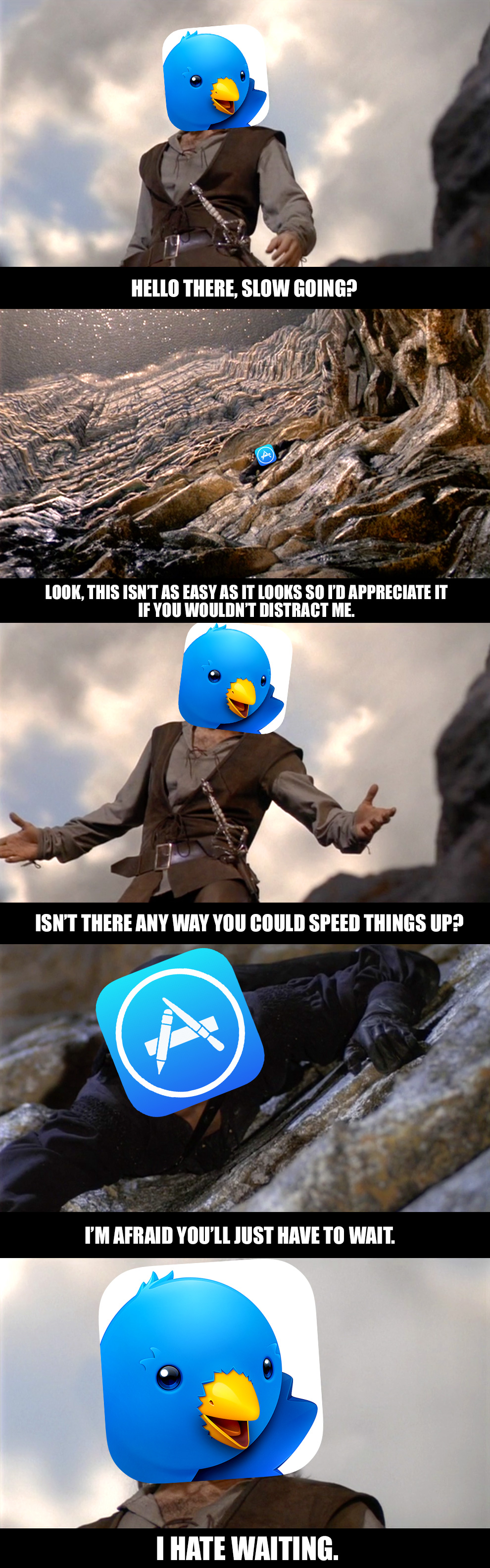
Magic 8-Ball, it’s been a while but I have some questions about Twitter’s recent blog post. You know, the one where they talked about “stricter guidelines” for how the Twitter API is to be used by third party apps. Since Twitter isn’t talking, I was hoping you might be able to clear some stuff up for me. Can I ask you some questions now?

Yes

All this talk about stricter guidelines and a “consistent Twitter experience” seems pretty ominous, should developers of 3rd party Twitter apps like me be worried?

Reply hazy, try again

I mean some people are calling Twitter’s non-announcement a “bombshell”. Are things really that bad?

Better not tell you now

What do you mean? Are you saying that 3rd party apps are about to become extinct or that Twitter just wants each app to display the timeline in a similar fashion?

Concentrate and ask again

I know Twitter’s got to start making serious money to pay for it’s massive overhead, are we talking about ads in the timeline?

Outlook good

If we’re talking about ads, I can deal with that. I’d rather have promoted tweets in Twitterrific than being forced to stop developing it completely.

What about expanded tweets, will Twitter force us to build some form of them into our apps?

Signs point to yes

If we don’t, do you really think Twitter would restrict API access and hang 3rd party apps out to dry?

Better not tell you now

That’s very comforting, thanks.

Don’t you think Twitter’s users would revolt if they took away our Tweetbots, Hibaris and Twitterrifics?

As I see it, yes

Damn straight they would. There are many developers and companies who have build their livelihood around the Twitter API since 2007. We even helped Twitter evolve and grow to where it is today. Are you saying none of that matters now?

Without a doubt

Frak.

Some developers are already suggesting we start creating a web-based, open alternative to Twitter using something like RSS. Would that really work? Would users really switch away from Twitter for a grass-roots service?

Don’t count on it

Do you think it’s a good idea for developers like us to keep coding away on their apps for now?

Most likely

Could the folks at Twitter have done a better job with their blog post to help stop the spread of paralyzing FUD?

It is certain

You really haven’t been much help to me. One last question…

Is the golden age of 3rd party Twitter apps over?

Ask again later

Meh! What do you know, anyway!

Ski Safari: 007 Edition

Lately I’ve been playing a great deal of Ski Safari, a wonderful casual game from Defiant Development for iOS. The game is a high score climber similar to the awesome Tiny Wings, in which you play play Sven, a skier trying to stay ahead of an ever-approaching avalanche. The object of the game is to simply get as far as possible, picking up coins, speed boosts and various forms of animals like penguins and even Yeti’s in a high-paced race to stay alive. Developers Brendan Watts & Shawn Eustace have done a marvelous job of making Ski Safari fun, addictive and immensely satisfying to play. I have a bit of a competition going on with a few of my friends as we play a high-stakes game of one-upmanship on the snowy slopes of the high Alps.

The game is pretty awesome as it’s designed, but I recently discovered I could make amp up the coolness by a factor of 10 or so simply by turning off the default music in the game and substituting my own action-packed soundtrack. And what soundtracks are best suited for racing down snow-covered mountains at breakneck speeds? Why none other than the ultimate spy, James Bond, of course! If you own any of theme tracks from the James Bond films, simply start them playing on loop and then turn off the in-game music to give yourself the ultimate action sequence experience. I’ve found that “Runaway” from Roger Moore’s For Your Eyes Only and “Bond 77” from The Spy Who Loved Me, are the perfect Ski Safari tracks, but your death-defying milage may vary.

Maybe the developers of Ski Safari will eventually see fit to make a James Bond-esque version of their game complete with bad guys on black snowmobiles, machine guns and deadly helicopters chasing you, but until they do, this is the next next best thing. Have fun and do try and come back in one piece, 007!

Ramp Champ’s Ticket to Ride

Back when Ramp Champ was released for the iPhone in August of 2009, it was one of only a handful of boardwalk style games in the App Store. Although it had taken much longer to produce than we had initially thought, all of us at the Iconfactory and DS Media Labs were proud of the effort. From its pixel-perfect artwork, and the fantastic original soundtrack to the design of Ramp Champ’s in-app purchases, every part was crafted with love. I wrote back then that the game was a huge risk for us as developers, but no matter what happened, I wouldn’t trade the experience for the world. All of us had tons of fun creating the game and the effort was hugely rewarding. Fans loved the rich graphics and cleverly designed puzzles that brought back memories of arcades and boardwalks long gone.

Shortly after Ramp Champ’s release, Skee-Ball by Freeverse hit the App Store and quickly stole Ramp Champ’s momentum. Skee-Ball was limited in its game play and far less graphically rich than Ramp Champ, but thanks to its straight-forward approach and realistic 3D physics, it became a huge hit. With Skee-Ball’s success, dreams of hitting the top 25 of the App Store quickly faded and although the game held its own, it never rose to the level that we had hoped it would. We produced several new add-on ramp packs for the game, but both the Iconfactory’s and DS’s resources were limited and we each turned our attention to other projects.

With the advent of the iPhone 4′s retina display 4 in June of 2010, Ramp Champ fans clamored for an updated version of the game with new high-resoultion graphics. The problem was that most of the content for the game was produced using raster (bit-mapped) graphics, not scaleable vectors and re-creating the entire game for retina proved cost prohibitive. For a while there was talk of a sequel that would be designed around all new vector graphics, and an internal prototype was even built, but it just wasn’t in the cards. Sometimes it’s difficult for small companies to devote time and money to a project when success is far from assured and such was the case with Ramp Champ. Its future seemed bleak indeed.

Then near the end of 2011, Ben Stahlhood and I started talking about DS Media Labs taking the reins of our favorite gaming son. DS had gone through some restructuring and was hiring fresh new talent to position themselves well for 2012. It’s always tough handing one of your most treasured creations to another to foster, but with Ramp Champ the move made sense. DS had been a fantastic partner in the game’s creation and we knew that if anyone was going to give Ramp Champ a bright future it would be them. With our development efforts focused on xScope, Twitterrific and the upcoming Astronut for iPad, we finalized the arrangement and I’m pleased with the result. I don’t know what’s in store for Ramp Champ any more than you do, but DS’s recent press release promises at least updated retina graphics, and I’m confident there will be much more to come after that.

All of us at the Iconfactory wish Ben and the gang at DS Media Labs all the best in their success. We look forward to rolling balls, knocking down those damn ducks and collecting tickets for even bigger and better prizes when Ramp Champ ultimately gets the update it so badly deserves. Good luck gang!

Retina iPad Roundtable

Rene Ritchie, Seth Clifford and Marc Edwards invited myself and App Cubby’s David Barnard to discuss the new retina iPad last week. Ep. 18 of the IterateTV podcast ended up being a smart discussion of the new devices’s strengths and weaknesses, tools and processes we use to develop for it and our take on the future of resolution independence. I spend some time talking about the Iconfactory’s upcoming retina work on Carcassonne and generally try to keep up with the huge brains of the fine fellows gathered around the microphone. If you design for iOS or just want to hear our take on Apple’s new hardware, check it out.

Effortless Unboxing

Apple already has one of the best unboxing experiences of any company on the planet. The industrial, packaging and graphic designers have gone to considerable pains to make sure that customers are extremely satisfied when they first open and activate their new Apple hardware. With iOS 5′s ‘PC Free’ technology, in combination with iCloud, Apple’s customers no longer need to attach their new iPhone or iPad to a desktop computer to start using it. All this is wonderful, but could Apple’s unboxing experience be even better?

Yes it could.

Imagine opening your new iPad that arrives by FedEx this morning, turning on the device and finding it already ready to use. No input of your Apple ID, no syncing of contacts, bookmarks or even apps. You turn the iPad on and it’s ready to go. Using the online ordering service via Apple.com in conjunction with your existing Apple ID, this kind of effortless unboxing experience could easily become reality. Ask any Kindle owner how awesome it is power on their new device and find all their books already there, ready to read. I could easily see an option at the end of Apple’s online ordering system that would give permission to use your Apple ID to pre-sync your new iDevice with your iCloud content.

There’s something to be said for the actual process of setting up your gadgets. The geek in us loves the discovery and rush we get from seeing, touching and exploring new technology and in that way, perhaps the current unboxing experience is superior. It gives Apple a chance to highlight just how elegant the process really is. That said, Apple is always designing for the 80%, not the geek and if that means giving customers the ability to simply open the box and go, I’m sure we’ll see it in the very near future.

[Hat tip: @BigZaphod @dlanham and @TandyQ contributed to this post]

Don’t Forget the Apple Care

As you head out to stand in line at your local Apple Store this Friday, or place your web orders for the new hotness from our favorite fruit company, do yourself a favor and don’t forget to buy your Apple Care. A friend recently asked me what accessories I would recommend for the new iPad. Without hesitation I would say the most important accessory you can purchase is Apple’s extended protection for your iOS or desktop hardware.

Extended warranties are nothing new of course, and even I hesitate to purchase them for household appliances or electronics, but not so when it comes to Apple Care. Apple does an exceptional job of servicing or outright replacing hardware when it’s defective and covered under Apple Care. Many issues can be fixed with a quick trip to the Genius Bar and those that cannot usually get taken care of in short order after just a few days.

When I bought my 27″ iMac in 2009 I purchased Apple Care right along with it. That $99 decision has saved me close to $1,200 dollars to date. A year or so ago my internal HD failed and had to be replaced which would have cost me over $400 in parts and labor. Then just this week I decided to fix a long-standing display problem with the same computer’s screen where light colors and gradients were being blown out and not visible. The Apple Genius I showed it to had never seen a similar problem before and since it was covered under Apple Care decided to just go ahead and order both a new display and a new video card. Total parts and labor for this trip would have cost me $798, but I pay nothing.

The best news is that with this Friday’s launch, Apple is bringing Apple Care+ to the iPad. Like it or not, the majority of damage to our (mobile) gadgets comes from accidental drops. Apple Care+ now covers your iPad for two such incidents and when the cost of replacing a screen is almost as much as the device itself, $99 suddenly seems like a steal.

Ask any geek who makes the best hardware, who’s products have the highest feeling build quality and they’ll most likely tell you Apple. Never-the-less technology inevitably fails. Hardware breaks and entropy rears it’s ugly head and when it does, trust me you’ll be glad you have it covered – spring for the Apple Care. The alternative is… unfortunate.

Charadium II, I Love You!

There are only a handful of games on my iDevices that have withstood the test of time and clung to my home screen. Some of these games include Carcassonne, Plants vs. Zombies, Orba, Tiny Wings and now Charadium II. Charadium is a classic Pictionary type game where players take turns drawing a word and guessing each other’s creations for points. There are a bunch of games of this genre in the App Store, but Charadium is far and away the best of breed I’ve played, and much of that is due to the attention to detail developer On5 has put into the app.

There are two main modes of play, Classic and Ping Pong. Classic lets you join a room with other random players or friends and compete in a round-robin, timed competition to guess words. The play is fast and furious and tons of fun. Drawings don’t have to be pretty they just need to communicate quickly. The faster someone guesses your word, the more points you will score. The other mode, Ping Pong, is my favorite when playing Charadium. Here you play with a friend and take turns drawing words from a list of three choices (easy, medium and hard). The harder the concept to draw, the more points you’ll net, but you also risk your opponent not guessing correctly at all. Incorrect guesses hurt your overall point total and can push your opponent to victory. I love Ping Pong games because they are not timed, you can play multiple games at once (like Carcassonne), and you get to choose the difficulty of the word to draw. Also, you’re not usually playing against random strangers so cheating (drawing words) is not an issue.

On5 makes a free and paid version of the app so you really have no excuse not to give it a try. Of course even the $2.99 iPad version is well worth the price and gives players full access to fun extras like more colors, more brushes and of course, no in-app advertising. This is a similar model we use at the Iconfactory for Twitterrific and it really is the best of both worlds. Charadium is also a great example of an app that improves measurably with each new update. In recent point releases, the game has added new brushes, new colors, the ability to play back all drawings (LOVE THIS), saving drawings to the camera roll and much more. There are still a few features I hope On5 adds like a paint bucket to quickly fill large areas with color, and a “Redo” command as well as undo, but overall the game play can’t be beat. Perhaps the App’s biggest failing, if there is one, is the need for greater stability. Ping Pong games sometimes get stuck and won’t advance, drawing previews are not always available or in-game chatting won’t dismiss. If the developers can find a way to make Charadium a bit more reliable, it would become one of my all-time favorite games for iOS.

If you love to draw, are looking for a fun, social game you can play in your spare time or like seeing how other players solve visual problems, Charadium II is for you. I enjoyed the game so much I bought a Cosmonaut Stylus from Studio Neat for my iPad just so I could draw better while playing. No matter what your level of artistic skill, there’s something for everyone to love in Charadium. Check it out!