My God, It’s Full of Stitches!

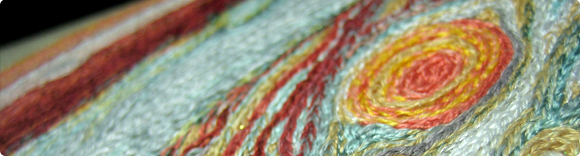
What do you get when you combine subjects like science and crafting? If you’re tumblr user pardalote, then you turn your considerable embroidery talents towards the heavens and the results speak for themselves. The level of detail contained in this amazing chain stitched version of the planet Jupiter was recently featured in MAKE craft zine and it’s easy to see why. The creator used images from NASA as a reference to capture the subtle colors and swirls of the gas giant in way that reminds me of van Gogh’s Starry Night. Even though the work is not for sale it’s safe to say any space geek would be proud to display this in their home. Check it out. Wonderful!

One Small Step…

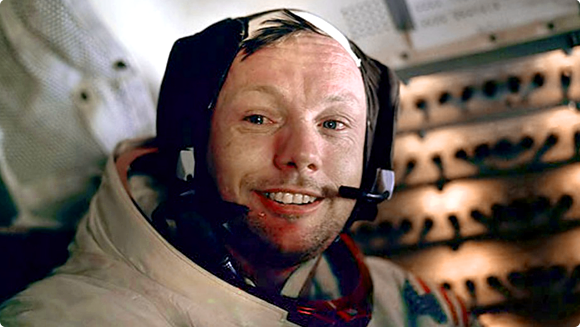
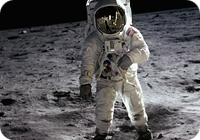
Aldrin took this picture of Armstrong in the cabin after the Apollo 11 EVA

Sad news today that the first man ever to set foot on the surface of the moon, Neil Armstrong, has died at the age of 82. Armstrong recently underwent surgery to relieve blocked coronary arteries but died today as a result of complications. Ever since I was a boy and first learned of he and Edwin “Buzz” Aldrin’s voyage to the moon, I’ve been fascinated with all things NASA. Both his name and the famous words he spoke as he stepped off the lunar module will forever be taught to children around the world. Indeed, the name of Neil Armstrong is surely one of the most recognized in human history along with other men of discovery such as Sir Francis Drake, Christopher Columbus and Charles Lindbergh.

The historic irony is that for the last 20 years of his life, he did his best to stay out of the lime light. He refused to sign autographs after 1994 and in 2005 became embroiled in a legal battle with his barber after Armstrong discovered the man sold a lock of his hair to a collector for $3,000 without Neil’s knowledge. Many have sought to use his name, and likeness for their own personal agendas but in the end Neil remained a man of dignity and quiet restraint. I can’t imagine what it what was like for him to become one of the most famous men in history overnight, but I’m sure the pressures to live up to other people’s expectations were intense.

It is also ironic in that Armstrong might not have been first to set foot on the moon if it were not for a series of random factors that resulted in he and Aldrin’s mission being selected to actually land. There’s a wonderful scene in Tom Hanks and Ron Howard’s epic mini series, From the Earth to the Moon, where Deke Slaton gathers all of the astronauts to let them know that one of them will be the man to actually be first. Although he did not know it at the time, Neil Armstrong was to be that man. The sense of history and significance that this realization represents is incredible and if you’ve never seen the mini series before, now would be the perfect time to check it out.

Today Armstrong passes from the realm of the living into those remembered, but even as he does so, it is certain his name and deeds will never be forgotten. I hope we one day set foot in the Sea of Tranquility again or perhaps upon the plains of Olympus Mons and remember all the small steps taken by men like Armstrong. Isaac Newton famously said “If I can see further than anyone else, it is only because I am standing on the shoulders of giants”. Armstrong was one such giant. Farewell Neil, we’ll miss you.

A Good Day for Physics

Amazing, historical news today from the European Organization for Nuclear Research (CERN), who says a new particle they’ve discovered fits the description of the elusive Higgs boson. If true (scientists are almost 100% certain), the discovery will likely unlock new age in the field of physics and greatly expand our understanding of how mass and gravity work. The so-called “God Particle” has implications for scientific discovery that I don’t pretend to even *begin* to understand, but I do appreciate the magnitude of today’s announcement. Although researchers stressed the preliminary nature of the results, the findings will most likely be supported by more data later this year.
The geek in me is overjoyed that the efforts of the CERN team in Europe have been realized, and that the discovery, first proposed by physicist Peter Higgs in the 1960′s has been made within his lifetime. I can only imagine how satisfying it must have been to see the results of these experiments confirm a theory you’ve held your entire life. About the only question left in my mind is how producer/writer Bill Prady will work the announcement into next season of The Big Bang Theory. Doctor Sheldon Cooper will be beside himself, and that’s no bazinga!

Thinking Critically

The older I get the more difficult it becomes to separate emotion from logic when making an argument. I find my increasing experiences and biases towards aspects of religion and politics and even science have made it more and more difficult to look at the world objectively. This is particularly acute when I get upset about political arguments made by those who lean right, be they on Twitter, on radio or TV. I’d like to think of myself as an open-minded person who takes in as many of the available facts before making a judgement on a particular subject, but that’s not always the case.

So when I came across this excellent series of videos by TechNYou dealing with critical thinking, I absorbed the presented information like a sponge. If you need a refresher on how to make an argument logically or how to recognize confirmation bias in your day to day life, I highly recommend them. Each part is very short so you can watch the entire series in no time. Enjoy and remember to ‘Think Critically’.

Part 2 – Broken Logic
Part 3 – The Man Who Was Made of Straw
Part 4 – Getting Personal
Part 5 – The Gambler’s Fallacy
Part 6 – A Precautionary Tale

Greenland’s Disappearing Ice Lakes

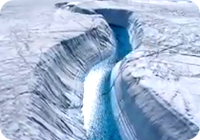
While the battle rages between climate deniers and the consensus of the scientific community, strange things are afoot in Greenland. The PBS series NOVA documents the country’s rapidly changing landscape with the help of survey photographer James Balog. Extreme Ice is broken into six parts but the most ominous segment deals with Greenland’s strange disappearing lakes.
In recent years the summer melt season in Greenland has grown hotter and now lasts two weeks longer than it did only a decade ago. This has resulted in huge, fresh water lakes forming on the ice sheet surface. Some of these lakes are miles in diameter and up to 50 feet deep. Although these melt lakes contain hundreds of thousands of gallons of water, satellite imagery has recorded their disappearances in just the span of a few hours. Years ago it was believed the water was simply re-absorbed into the surrounding ice, but recent surveys have discovered something more dangerous. The water is boring down through the ice to the bedrock below and lubricating the entire ice sheet of Greenland. The implications of this, if true, are staggering.

One such amazing lake event was witnessed first hand by the NOVA team and documented for the special. The entire 60 minute broadcast is available on the PBS website and is worth your time. Watching these incredible frozen landscape melt away is strangely beautiful but deeply unsettling. As climate skeptics dominate the media and introduce measures in government bent on denying action to stop the effects of man-made warming, Greenland is slowly but surely slipping away. The debate about what’s causing climate change may never end, but the real question now is what are we doing to prepare for the coming disaster?

The Tiny Stuff of Nightmares

When I was 5 or 6 years old, my parents took me for vacation to Hawaii. It was the first time I remember going someplace other than Disney World and the whole trip is full of wonderful memories, except for one fateful encounter that happened on Oahu. While playing on the beach, I strayed from my parents for just a few moments and happened to come across an amazing discovery. There, being washed in from the ocean was a beautiful iridescent balloon that looked like it was made from glass. I ventured closer to claim the fascinating treasure for my mom & dad and when I reached down to pick it up, my nightmare began.

Of course the balloon was nothing of the kind, but was in fact a Portuguese Man o’ War which had washed up on the beach. When I touched it I was immediately stung and ran screaming for my parents. I don’t remember much after that, but my parents tell the tale of how they rushed me to the local hospital where they spent the rest of the day in the emergency ward with their frightened son, in great pain as I dealt with being stung by one of the scariest creatures in nature.

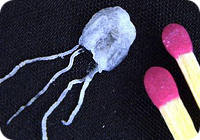
That is unless you’ve encountered the tiny Irukandji jellyfish (pictured here) as did a man from north-east Queensland, Australia last week. The man thought he had taken the proper precautions by donning a full-length “stinger suit” which covers everything except the hands and face to protect against jellyfish stings. As fate would have it, he dove head first into the water and was immediately stung in the face. Since there is no antivenom, victims must endure excruciating pain, muscle spasms, vomiting and in some cases, death. Blood pressure can rise as high as 280 over 180. The little creatures are so deadly in fact that in 2002, two tourists were killed in two separate incidents of the coast of northeast Australia. All this from an animal no bigger than your thumb.

At last report the man was in serious condition at Mackay Base Hospital, 600 miles north of Queensland. I can only imagine what he’s going through right now and I wish him and his family well. Sitting at our computers, playing with our cell phones and watching TV, it’s sometimes easy to forget the awesome power of nature. We watch the Discovery Channel in HD and sometimes they even show us the amazing life cycles of these creatures, but few of us ever actually encounter them. Speaking from experience, I can honestly say I’d like to keep it that way.

New Blue for You

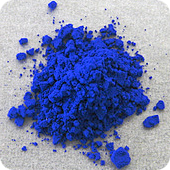
The New York Times reported this past week that chemists at Oregon State University have created an all-new, extremely durable and intense blue pigment. Like so many other famed scientific discoveries, this one came as a complete surprise to Mas Subramanian, a professor of material sciences, who was attempting to make new compounds for use in electronics.

Subramanian and his fellow professors discovered that by mixing manganese oxide with other elements and heating them to very high temperatures (2000 degrees F), crystals were formed that reflected only blue light. The potential uses for this new pigment are vast, especially since so many of the modern blues in use can fade or, in some cases, are toxic. The only stumbling block seems to be the use of an expensive chemical, indium, which the researchers are now attempting to substitute for a less expensive component.

I love stories like this because it reminds us that science isn’t always about creating super conductors or finding a cure for cancer. Although such discoveries are important in their own right, finding a new blue reminds us that chemistry is the basis for everything in the natural world, including the colors we see each and every day. An awesome, elegant and artful combination.

What’s Wrong with the Radish?

Something’s wrong with the humble radish. When I was a kid I remember these funny little root vegetables burning my face off from just a single bite, but lately I’ve found they have no more kick than a cramped kangaroo. Part of me suspects that the heat of the modern day radish has somehow been bred out of it for a wider appeal to mainstream American consumers. A quick check of Wikipedia reveals that there are no less than 10 common varieties of radishes. The Cherry Belle is the version most often purchased in North American grocery stores. From the taste and smell of them they must be some of the blandest radishes on the block.
I first became addicted to radishes when I was very young. My aunt grew them in her garden and would often give them to me and my cousins to chomp on along with freshly dug carrots. Aunt Lorraine’s radishes were strong enough to put hair on your chest and I loved them to death. I also remember the veggie from the Passover celebrations in my church. Part of the ritual involved eating “bitter herbs” and although radishes were probably not historically accurate, I distinctly remember eating slices of radish on pita bread while listening to Fiddler on the Roof. Come to think of it, I’m not sure why our Catholic parish ever celebrated a Jewish event, but I’m glad we did because that’s where I learned to love radishes.

These days radishes might as well be turnips or potatoes because they have about as much flavor. I’ve searched high and low for radishes with heat and not found any in years. The topic came up at lunch today with the guys from work and David suggested checking out the locally grown radishes of the Piedmont Triad Farmers Market. I’ll be heading there this weekend to do some research and hopefully return home with my hot-headed pearls. If all else fails, you can be sure I’ll be sending away for my own super-hot radish seeds next spring. By hook or by crook, the heat will be on!

Unburdened by Evidence

Human beings love conspiracy theories. We are all born and raised with certain biases that taint our world view, so when events unfold in ways we don’t agree with, we tend to make up reasons to bargain away the result. True believers of two such conspiracy groups have gained media attention in recent weeks – Obama “Birthers” and those who insist the Apollo moon landings were faked.


Those who subscribe to these conspiracy theories have several legs up on reality that make them both frustrating and infuriating to try and deal with. Their foremost advantage is that, in scientific method, it is difficult to prove a negative result. This is doubly so when the people in question refuse to acknowledge the rule of law, insist on approaching the argument from preconceived viewpoints or simply make facts up to suit their needs. All three which are routinely done by birthers and moon hoax believers.

In the case of Obama Birthers, as they are called, despite piles of physical and legal evidence that Barack Obama was born on August 4th, 1961 in Honolulu, Hawaii (one of the 50 United States) these fringe elements insist that Obama is not a citizen. When one fact is presented, such as the authenticity of his birth certificate (certified by the Republican governor of Hawaii herself) the birthers shift gears and instead claim Obama is trying to block the document’s release. Or they claim that since Obama’s father wasn’t a citizen at the time of his birth, than means neither is Barack. Forget the fact that simply being born in the U.S. grants one “naturalized status”, or that 2 separate Hawaiian newspapers announced Obama’s birth on the same day in 1961. None of this evidence meets their warped criteria of truth.

Then you have disturbing people like Bart Sibrel, a total nutjob who insists that NASA faked the Apollo moon landings in order to beat the Russians in the eyes of the American public. As we approach the 40th anniversary of this landmark event in human history, mainstream media feels the need to shine the spotlight on people like Sibrel. It is true that millions of Americans living today have no memory of the actual event, but that makes it no less factual than Lindbergh flying solo over the Atlantic or the Wright brothers flying at Kitty Hawk.

Many people find the idea of Sibrel’s beliefs disgusting and disrespectful to the dedicated men and women of NASA. Not to mention the over 400,000 people who worked for the better part of a decade to land men on the moon and return them safely to the Earth. Professing the moon landing hoax also denigrates the memory of those lost in the attempt like Command Pilot Virgil I. “Gus” Grissom, Senior Pilot Ed White and Pilot Roger B. Chaffee who died on the launch pad of Apollo 1 early in the program.

For birthers and moon hoax pushers, reality doesn’t come into play. No amount of evidence would ever be enough to assuage them from their pre-held beliefs. This is the root of their fallacy – that they purport to be interested only in the truth, yet when directly presented with overwhelming piles of it, retreat to the excuse of conspiracy. Some say we shouldn’t confront such fringe elements, that they don’t deserve the legitimacy our attention pays them. This may indeed be true, but simply ignoring the screaming man in the corner doesn’t make him go away. He’ll still be there screaming and he’ll get louder the longer you ignore him. No, the answer is to confront these kooks head on and if reason won’t work, as Astronaut Buzz Aldrin will tell you, try a good right hook.

Wilkins Ice Shelf Close to Collapse

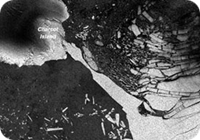
News today that scientists in Antarctica are reporting that the Wilkins Ice Shelf is “imminently” close to breaking away from the Antarctic Peninsula. The shelf, which is roughly the size of Connecticut, has been destabilizing for the past 20 years and is now on the verge of collapse.

Since the mass is already floating, the breakup won’t raise global sea levels, but it is none-the-less distressing. Wilkins, like all ice in Antarctica, is formed over thousands of years by accumulated and compacted snow. Surveys of the ice shelf over the past century reveal that it had been stable until the 1990′s. In February 2008, the shelf dropped 164 square miles (425 square kilometers) of ice. In May it lost a 62-square-mile chunk.

Meanwhile a new joint report by Muyin Wang of the Joint Institute for the Study of Atmosphere and Ocean and James E. Overland of the National Oceanic and Atmospheric Administration’s Pacific Marine Environmental Laboratory says that Arctic sea ice is melting faster than expected. Overland and Wang combined sea-ice observations with six complex computer models to predict a decline from about 2.8 million square miles normally to 620,000 square miles within 30 years.

Despite all of the apparent evidence, recent polls indicate that fewer and fewer Americans are concerned with global warming. While its difficult to focus attention on environmental matters in the midst of a planet-wide recession, climate change is indeed happening and will continue unless action is taken. The science is speaking to us, we’re apparently just not listening.

UPDATE: It’s happened. The BBC is reporting that according to satellite imagery taken on Sunday, April 5th, the Wilkins Ice Shelf finally snapped. You can watch their report regarding the break up at The Huffington Post.